
What's IN the Beef?

Back in the 1980s, a popular TV commercial for Wendy’s hamburgers hit the airwaves with the catchy tagline, “Where’s the Beef?” This was a time when big-budget fast-food chains were exploding and dotting the American landscape faster than pigeon droppings.
Today, the more pressing question should be “What’s IN the Beef?” Or any food we eat.
Increased rates of cancer, stroke, heart attack, diabetes, high blood pressure, and dementia have also increased consumer awareness and dietary choices. Ignited by the relentless degradation of the environment and the pervasive corruption in the meat, poultry, fish, chemical, and organic food industries, the controversial and often heated debate regarding the choice between an animal-based diet and a plant-based diet has moved into a new and more important arena. Consumers of animal products, whether they care to acknowledge it or not, are now faced with the choice of continuing to eat foods heavily laced with toxins, such as meat, fish, and poultry, or a plant-based whole-food diet with considerably fewer toxins.
P L O P S
Dr. Michael Greger, founder of Nutritionfacts.org—a user-supported website that accepts no corporate sponsorship—revealed the following in a recent video presentation:
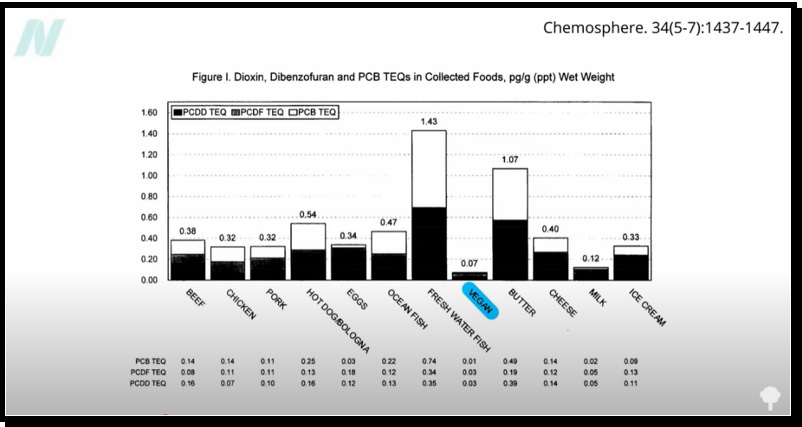
We lack robust safety data on most of the estimated 30,000 chemicals in wide commercial use registered under the U.S. Toxic Substances Control Act. But the greatest concern may lie in the long-banned legacy chemicals that continue to contaminate the food supply, known as PLOPs—persistent lipophilic organic pollutants. These include dioxins, PCBs, and insecticides such as DDT.
Every year in the United States, billions of pounds of slaughterhouse by-products are produced, the vast majority of which are fed right back to the farm animals––particularly chickens, which can recycle toxic heavy metals and industrial chemicals back into the food supply. Lead builds up in bones and mercury attaches to the protein (which is why egg whites can have four times more mercury than yolks). Most of the lead in the bone meal passes right through the animals into their waste, but then producers can take that waste—cow, pig, and chicken feces—and feed it back to the animals again. So, you can see how the levels of contaminants might build up in their bodies, even when the animals themselves may be natural herbivores.
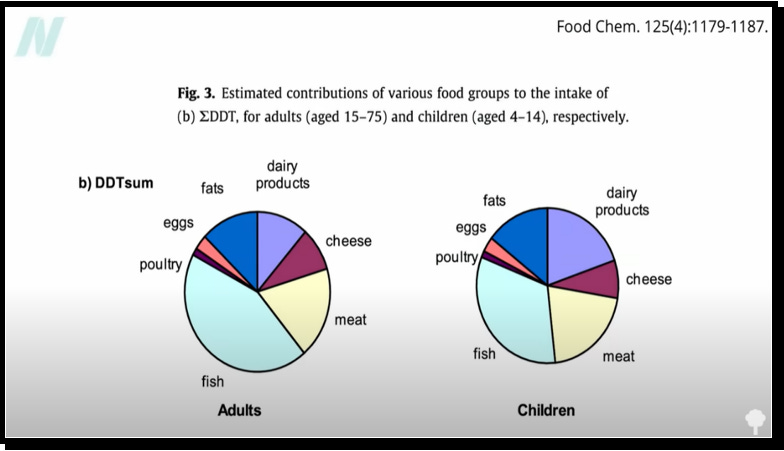
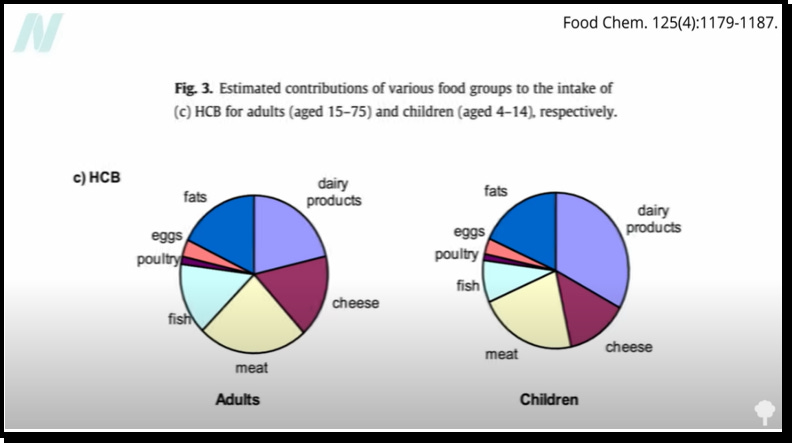
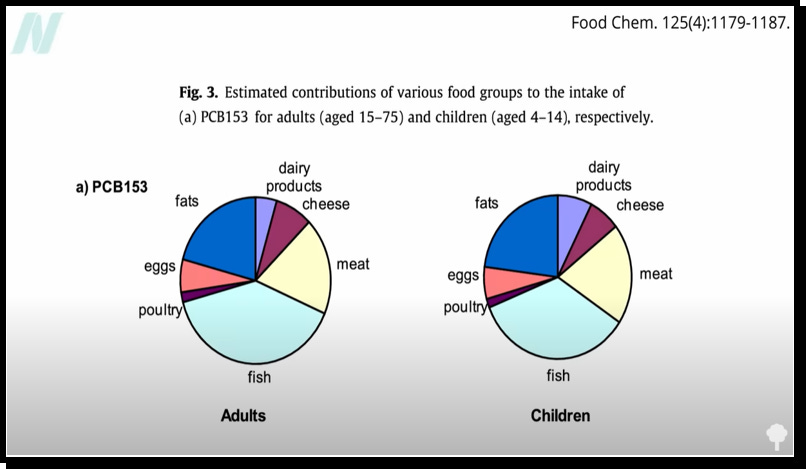
The following charts detail the level of toxic intake by demographic:
Dichloro-diphenyl-trichloroethane (DDT)
Hexocluorobenzene (HCB)
Polychlorinated biphenyl (PCB)
Animal Products: Organic Grass-fed vs Conventional
Many consumers have been led to believe that organic grass-fed beef and other animal products are free of harmful toxins. This has been the mantra promoted by the organic sector of the meat and poultry industries for years. Dr. Greger addressed this misconception:
Surprisingly, the consumption of organic meat does not seem to diminish the cancer-causing potential associated with the PLOPs in meat. All samples were found to be contaminated, with minimal differences between meat raised organic versus conventional.
Levels of Toxicity by Product Consumption
A Paradigm Shift in Government Regulations
Part of the problem is a lack of public awareness and the seeming implacable belief by most consumers that the United States Department of Agriculture (USDA) has their back.
In 2016, the FDA ruled in favor of removing mandatory country-of-origin labeling requirements for beef and pork muscle cuts, ground beef, and ground pork. When consumers see USDA stamped on packages, the assumption is that the meat they are purchasing is homegrown when nothing could be further from the truth. Beef and pork are the only two products imported into the United States of America that do not require a country-of-origin label, an industry-wide acronym referred to as “COOL.”
In a 2024 interview, Texas cattle rancher Shad Sullivan explained that multi-national corporations are taking over the food industry. The four main globalist-owned corporations, Cargill, Tyson Foods, JBS, and National Beef, currently operate 85% of the United States beef industry.
Glyphosate: Public Enemy #1
Back in the early to mid-2000s, my interest in food production prompted me to secure certifications in horticulture, composting, and soil management. It was then that I first learned about glyphosate, the active ingredient in the herbicide Roundup..
A report published by “World Animal Protection US” revealed:
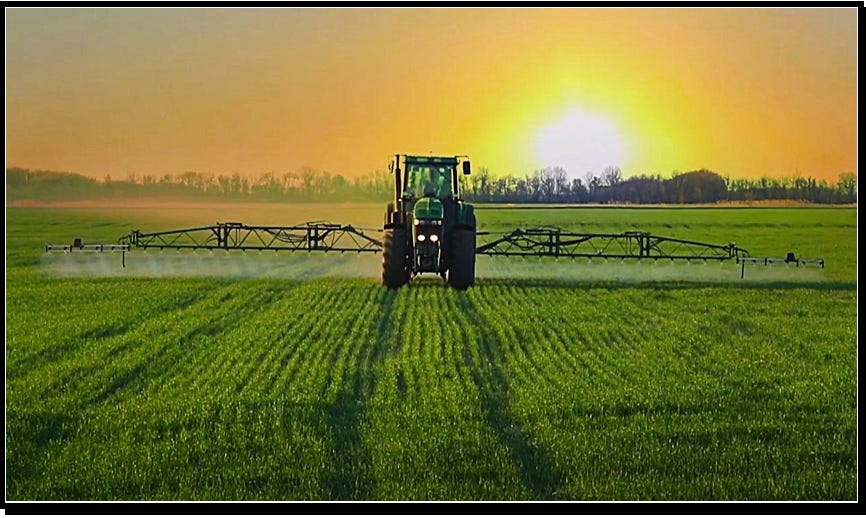
Wildlife and farmed animals are both suffering on a massive scale, and in many cases the culprit is the same: toxic agricultural pesticide use. When most people grab a burger, the last thing they’re thinking about is pesticides. But meat production is a driving force behind the use of massive amounts of deadly pesticides in agriculture. In 2018, the most recent year with full data available, an estimated 235,976,274—nearly 1/4 billion—pounds of herbicides and insecticides were applied in the US just to the corn and soybeans grown for farmed animal feed [emphasis added].
The Effects on Farming Communities
Urban centers like New York and Los Angeles have long been considered the most polluted cities in the United States. Sadly, the advent of large-scale industrial agriculture and the growing use of toxic pesticides to increase crop yields and bolster profits is rapidly changing this assumption.
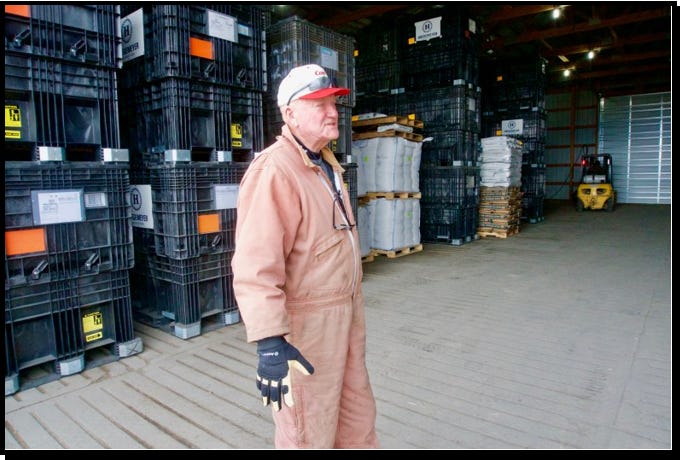
The long-term effects of glyphosate and other chemical toxins on farming communities have been devastating. Probably the most glaring example of this is Iowa’s Palo Alto County where glyphosate is used to facilitate the production of corn and soybeans, the county’s two major crops used for animal feed and the production of ethanol.
In 2024, Investigate Midwest published an article titled “An Iowa Farm County Seeks Answers to Cancer Rate 50% Higher than National Average”:
Concerns about connections between the farm pollutants and cancer have been mounting, particularly in Palo Alto County, which had the highest incidence of cancer of any county in the state and the second-highest incidence of cancer among all U.S. counties, with 83 new cases of cancer on average each year in a population of 8,996, according to a 2023 report by US News.
The five-year incidence rate for cancer in Palo Alto County is 658.1, far higher than the national five-year average of 442 new cancer cases reported for every 100,000 people, according to the National Cancer Institute.
Lawsuits Abound
The “Lawsuit Information Center” reported:
As of October 2024, Monsanto [the company responsible for producing Roundup] has reached settlement agreements in nearly 100,000 Roundup lawsuits. Monsanto paid approximately $11 billion. Bayer has accomplished this by negotiating block settlement arrangements with plaintiffs’ lawyers who have significant cases in the litigation … and by settling with plaintiffs before trial.
Although these settlements account for nearly two-thirds of all Roundup claims, Monsanto estimates that 54,000 active Roundup lawsuits remain. Most lawsuits have been filed in state court, but over 4,000 claims in the MDL [multidistrict litigation] Roundup class action lawsuit are still pending in California.
----------------------------------------------------
In his 2019 article “Geo-Economics and Geo-Politics Drive Successive Eras of Predatory Globalization and Social Engineering - Historical emergence of climate change, gender equity, and anti-racism as State doctrines,” Canadian researcher Denis Rancourt explained that accelerated globalization and USA corporate deregulation following the 1990s dissolution of the Soviet Union (USSR) coincided with a surge in agricultural use of glyphosate and the initiation of several unprecedented chronic disease epidemics, which have only intensified to this day.
----------------------------------------------------
Glyphosate has been linked to cancer, Parkinson's disease, liver and kidney damage, and endocrine, reproductive, and digestive issues. Despite the overwhelming evidence detailing the harmful effects of glyphosate on humans and animals, the US Environmental Protection Agency (EPA) and other government agencies continue to claim that glyphosate is safe for consumption “up to the established tolerances.”
Call me crazy, but I can’t imagine what the “established tolerances” might be for a toxic herbicide, or what sane and rational human being might find any level of toxicity acceptable for human and animal consumption. ¯\_(ツ)_/¯
Injecting Livestock with mRNA Vaccines
BREAKING! State Departments of Agriculture Support Farmer and Rancher Access to Approved Vaccine Technologies.
In a 2024 press release, the National Association of State Departments of Agriculture’s (NASDA) CEO Ted McKinney said:
NASDA prioritizes the well-being of livestock and public health, and we must ensure farmers and ranchers have access to approved mRNA vaccines to ensure the health of their animals and provide a safe and resilient food supply.
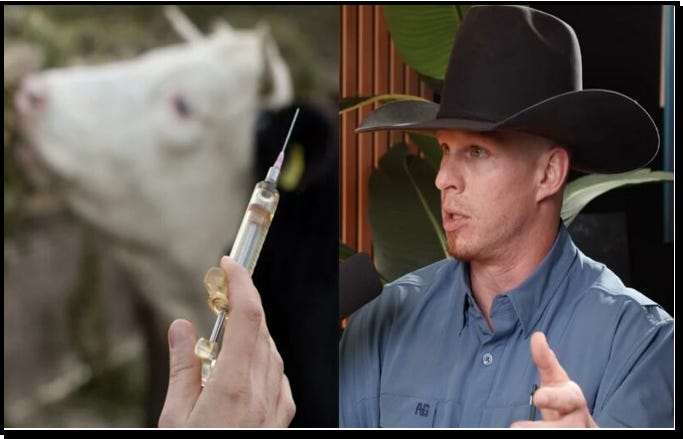
Contrary to NASDA’s efforts to promote “mRNA vaccines to ensure the health of their animals and provide a safe and resilient food supply,” fifth-generation boots-on-the-ground cattle rancher Braden Jensen tells a different story.
In an interview with the Real Business Owners Podcast, Jensen revealed the USDA’s efforts to use the “bird flu” outbreak as a pretext to digitally tag and inject cattle with mRNA vaccines. He said that in early 2024, the USDA introduced electronic identification tags (EID) and tried to make them mandatory for all beef and bison producers in the US. These microchips track everything—vaccines, feed, even the animal’s age. The USDA wants oversight at every stage of production.
Jensen went on to say that the government is developing new mRNA vaccines for bird flu and respiratory diseases in cattle. He highlighted a troubling study involving 500 pigs given mRNA vaccines. He said that the USDA came out with a study on pigs because pigs were the first to be trialed with the mRNA vaccines. Within a couple of weeks, about 100 pigs died—they got so sick they stopped eating, with symptoms like severe diarrhea and dehydration. When the meat was tested later, they still found traces of the vaccine. So, if people don’t want to get the shot, they might be getting it in their food instead.
Jensen’s fears echo those of other ranchers and consumers concerned about the implications of mRNA technology for both livestock and the public at large, and he warned that this isn’t just about keeping animals healthy—it’s about forcing ranchers into a system with no choice. We need to seriously consider the consequences of having mRNA in the meat we consume.
Make America Healthy Again (MAHA)

Rest Assured We’re in Good Hands
Nothing says MAHA like President Trump and Vice President Vance coming together with RFK Jr., Trump’s nominee for Secretary of Health and Human Services, and Department of Government Efficiency czar Elon Musk, and son Donald Trump Jr. for a celebratory meal of McDonald’s hamburgers filled with “pink slime,” French fries made with a yummy mix of 19 ingredients including a toxic blend of dimethylpolysiloxane, tert-Butylhydroquinone, sodium acid pyrophosphate, hydrogenated soybean oil, and a 16 ounce Coke with enough sugar to send your glycemic index through the roof.
Reducing Exposure to Toxins
At this moment in America’s rapidly evolving history it’s safe to say that no foods—be they animal product or fruits and vegetables—are truly free of harmful toxins. However, there are a few precautions one can take to reduce exposure to toxins in the food supply.
Dr. Greger suggests:
Eating high-fiber foods, as fiber can bind to some of the contaminants and flush them out of the body.
Exercise regularly. Blood levels of persistent pollutants have been found to be lower among physically-active [sic] individuals, perhaps due to sweating, or due to a potential boost in detoxing enzymes, or increased clearance through the bile, at least in rats.
In addition to Dr. Greger suggestions, I would also recommend:
Reading food labels carefully. If you spot an ingredient that you never heard and can’t pronounce, chances are it was concocted in a lab and not good for you.
Buying organic fruits and vegetables.
Here’s the thing: There is no guarantee that products labeled “certified organic” are in fact 100% organic, but there is a more than better chance that they are in fact organic. Whereas, if you purchase products labeled “conventional,” you are 100% certain that they are not organic, and probably grown with glyphosate and other toxic herbicides and pesticides.Knowing the source location of your fruits, vegetables, grains, and legumes. Are they grown abroad? Are they grown in the US? If so, is the farm, production, or distribution site of your product produced within a 150-mile radius of a toxic disaster like the train derailment in East Palestine, Ohio, or the more recent lithium factory fire in Monterey County, California, within miles of an expansive area of farmland referred to as “America’s Salad Bowl.” These are concerns that should be given careful consideration.
Additional Resources:
“Vaccines in the Food Supply: What Are the Risks?”
https://brownstone.org/articles/are-there-vaccines-in-our-food-supply/Is Organic Meat Less Carcinogenic?
https://nutritionfacts.org/video/is-organic-meat-less-carcinogenic/FROM THE REAL ORGANIC PROJECT: Peter Whoriskey: Uncovering Fraud In Organic Meat, Milk, Eggs, + Grain
https://realorganicproject.org/peter-whoriskey-uncovering-fraud-in-organic-meat-milk-eggs-grain-episode-six/How Fast Can Children Detoxify from PCBs? https://nutritionfacts.org/video/how-fast-can-children-detoxify-from-pcbs/
How Long to Detox from Fish Before Pregnancy?
https://nutritionfacts.org/video/how-long-to-detox-from-fish-before-pregnancy/Pollutants in Salmon and Our Own Fat
https://nutritionfacts.org/video/pollutants-in-salmon-and-ou-own-fat/Dietary Pollutants May Affect Testosterone Levels
https://nutritionfacts.org/video/dietary-pollutants-may-affect-testosterone-levels/Got the Facts on Milk?
Got the Facts on Milk? is a feature documentary that dared to question the much-publicized health benefits of milk and dairy products.
“A girl’s quest to find out what is really wrong with the milk, only to be booted off the USDA grounds for asking the wrong questions.”
Is Plant Protein Healthier Than Animal Protein? | Dr. Joel Fuhrman